Showing posts with label writing tips. Show all posts

Sunday, 1 December 2013

Writing Descriptions

Descriptions are an important part of the story. They help to create the atmosphere and, especially in fantasy and science fiction, they add to the world building. But how much should a writer describe and how much should be left to the imagination of the reader? 

This is a difficult question and there really is no right answer for it. Some readers love a lot of description while others get easily bored by it and rather skip it. For me, it all depends on the skill of the writer. Yet I do not want page after page full of descriptions. I often forget it anyway. Some writers describe their characters in elaborate detail, but the most I tend to remember is their hair colour, eye colour and their build or other remarkable details such as a scar or a tattoo. The shape of their eyes, their nose, his large feet or their unusually small ears vanishes from my mind quite quickly, unless it has been repeated a couple of times or the writer put an emphasis on it. I create my own image of a character, building, place, etc. in my mind on the basis of the information I can remember. 

For me, the most important role of description is that it helps to get to know the characters. If you give description from the point of view of one of your characters, you should focus on what the character will see, hear, feel and smell. A character that has not eaten for quite a while, will notice the smell of food before (s)he sees the expensive tableware and the painting of an alien on the wall. The character who loves art will most likely see the painting of the alien first and (s)he shall look at it in more detail than the hungry character. 

Description can also bring your story alive. Often small details have a major impact on convincing the read that the story you are telling is real. In Harry Potter we do not get to see every detail of the shops in Diagon Alley, but J.K. Rowling describes just enough to let the whole street come to life. The best way to make your world come to life, whether if it is a world you build yourself or our word, is to make use of every sense. Too often smell and sound is left out and then you get a flat image. If there is a fire, describe the sounds. How it roars as it destroys everything in its wake or how a dungeon smells of death and decay besides describing how dark and cold it is. You want to make your readers shiver as they plough through the snow with your characters; you want them to smell and taste the freshly baked bread and feel how soft the fur of your monster is. 

Create the atmosphere, point out how expensive his clothes look and how the tiger’s coat looks in the setting sun, but do not describe every drop of rain, every wrinkle in his clothes or every stripe on the tiger’s coat. Leave some room to let the reader build the world in his head. I like to think of the descriptions in stories as the foundations of the reader’s imagination.

Saturday, 5 October 2013

Let Your Characters Make Their Own Decisions


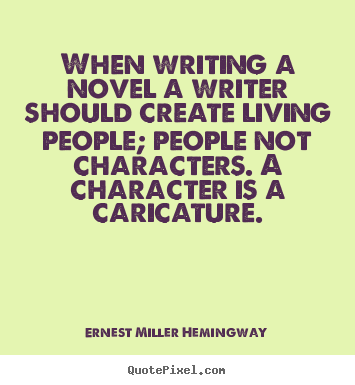
Characters are the soul of the story. They are born out your imagination and ought to grow beyond it. Let them become more than ink and paper. Let them come to life! Unless you have Frankenstein like ambitions, they will never be made out of flesh and blood. But as a writer, you have the prefect excuse to have imaginary friends. It would be a shame not to use it!

Get to know your characters well. Go to a bar with them, take them with you on a walk through the woods or play truth or dare with them. It does not matter how you get the know them, but it is important that you do. Your whole story will be spun around them. The characters that stay with us long after we finished a book. 

When you know your characters, you will know what drives them and what choices they will make. This is very important if you start building your plot. You cannot force your character to take a certain decision that will be more favourable for the plot. They have a mind of their own and they are driven by their own motivations. That is why it is important to create the plot around the characters and let them influence the plot by their choices. Do not bend the characters in such a way that they fit into the plot, but bend the plot. 

source: Google Images
That is why I barely plan the plot ahead. I know what the main conflict in the story will be and I have an idea of how it is going to end, but what happens on the journey is something I have yet to discover. While writing I come up with events that can happen during the stories and while I am looking forward to write them, they might not end up in the story because of a certain decision a character makes. 
I spend a lot of time writing a certain scene that was  supposed to be pivotal in the healing process of one of my characters. The scene would give him insight of what had happened to him and how he could continue on living his life. I knew exactly how the scene was going to be. I pictured every detail in my head. Unfortunately the scene did not fit the character. It would have this enlightening effect that it was supposed to have. 

When I start writing a story, I know where it will begin and I have an idea about how it will end. Sometimes I have ideas about events that can take place throughout the journey the characters make. When I write I get into the head of my characters. I discover most of the story while I travel with them through it. This makes it very easy for me to respect my characters and accept the choices they made; even when that means that very cool event I was dying to write will not happen. On the contrary, it would damage the character even more unless I would force him to think a certain way and perceive certain things in a different way. It would be very out-of-character for him. It was a tough decision the scrap the scene because I already put quite some effort and time in it. It was for the greater good. 


Getting to know your characters well will take a while. You will never know them as well as you think you do and that is great. Nothing is as thrilling as discovering something surprising about your characters. Let them be born out of your imagination, let them grow beyond the page and give them their own voice, thoughts and emotions. Respect them and never force them to do things they would not do. If you want your character to do something uncharacteristic, make sure you have a good reason for it. Maybe another character forces him/her to do it or perhaps he/she will lose something/someone very dear to them if they do not do it.

Thursday, 29 August 2013

Kill Your Darlings

My favourite character out of the series I am writing is very complex and difficult to understand. He was hard to get to know and seemed to try and evade me. The more I get to know him, the harder it became to fit him in the story. There was this one thing that happened in his past that would influence how he coped with certain events and this would have a great impact on the story. More and more it seemed as if the story needed to bend around him in order to make him fit in, but he is not the only character. It just did not feel right.

 At that point I started to consider that perhaps this was not his story. But I was not going to give up that easy. I did not want to give up on him so easy because to me he was far more than just another character. Parts of me are in him and he is very loosely based on someone that I admire a lot and has been inspiring me for a decade. I did more research in the hope to find something that would enable me to bypass his problem and make him fit in the story nonetheless. The answers I found were not the ones I wanted. Maybe this was not meant to be.


I was very close to killing him. I did not want to and the thought alone made me very sad, but it he would probably cause the whole story to come crashing down and I wanted to avoid that at all costs. I ensured myself if I had to kill him, I would not bury him. When the time was right, I would resurrect him and give him his own story. But luckily I did found a solution. A very simple one, actually. The trauma of his past was not important for the story, so why would I make him suffer so much? Taking the trauma away wouldn't fundamentally change him but it would make him able to be in the story. Everything is now starting to fit together again and I am very relieved because of this.  

But finding a solution for one character/scene/plot point/sentence/... does not mean there will always be a way to make it fit. You always have to look at the bigger picture. If something does not fit in, do not force it. It will make your story's quality go down. It is not because you kill it now, that you cannot use it later. Keep a notebook or a document were you save all the ideas and things that had to go because it did not fit. Maybe in time you find a way to rehabilitate them. Writing is great fun, but sometimes I can be very hard and it can even suck. Turn your heart into a stone and kill everything that does not fit.


"Kill your darlings, kill your darlings, even when it breaks your egocentric little scribbler's heart, kill your darlings."
On Writing by Stephen King

Monday, 26 August 2013

Writing Habits

A while ago I did a blog on reading habits and I decided that doing one on writing habits might be fun. I have been writing for about a decade now, though I only started writing seriously a couple of month ago. Thus I am still trying out new ways to work. 

I try to write every day. I do not set myself goals for the days as in how many hours I will be writing or how many words I want to write. Some days when I am having a down day or when I am very busy, it is just very hard to write. Still I try to get some words on the page, even if the writing ends up to be very bad. Bad writing is better than no writing. I fail the write daily more often then I want to, especially now that I am studying for my resists it is very hard. When schools start again in autumn, I hope I will finally plan everything in on a weekly basis and commit myself to that planning. I am, however, notoriously bad in planning.

source: google images
I hate being disturbed while writing. It can kill my flow. Most of the time I do the disturbing myself. The internet and not picking the right writing music are things that easily distract me. I like to chat with my friends and I do not stop a conversation when I am writing. It is not rare that I spend most of the time chatting instead of writing. I actually should close down the internet when writing, but I often use google translate to check up words seeing English is not my first language. Also the internet is easy for research. Writing with the internet open, is a very bad habit of mine. I really should try to close the internet more often or just ignore the people who are trying to talk to me until I have finished a paragraph or a scene.

Without a doubt my worst habit is wanting to rewrite scenes all the time. I have a hard time controlling my inner critic. When I reread something I have written previously, I almost always want to write it all over again because I know I can do it better. I should, however, leave that for another draft or else I have the risk to end up in a circle of never-ending edits or making myself very annoyed. Yesterday I spent a lot of time on writing a significant conversation and when I reread it today in order to continue, I wanted to make a back-up of the whole thing and start all over again. I managed to restrain myself so far, but it makes me frustrated and loose my enthusiasm to continue. 

I tend to keep everything related to the story in my head. I have a fairly good memory and I know that I am not likely to forget good ideas. I know everything would be much more organised when I would write it down, especially since I am working with a co-writer. I love world building until I have to write everything down. Because I have absolutely no clue what the best way to organise everything, I cannot stand to write it down. It somehow always makes it look very messy and disorganised. A giant cork board would be handy, but I have no room near my computer to hang something like that. I have, however, decided to scan in all my notes instead of typing them. It saves me a lot more time. I am also considering on using cards to write world building things on them and file them in a particular way. The downside of that system that I might end up with tons and tons of cards because they are so small.

I could go on for a little while longer, but as this blog is getting quite long, these habits (looking back on it, I a doubting if habit is the right word, but for now I cannot think of anything else) are the first ones that sprang into my mind. I might do another blog on something similar in the future about how I write, but I'm very busy now and leaving on a holiday in two weeks, so I might take a while before I write another blog.

If you have tips how I can improve these 'habits' or sort my world building organising problem, feel free to share in the comments. I would also love to read about your habits!


Friday, 2 August 2013

Writing Courses.

There are a bunch of writing courses out there, both for academic and creative writing. I myself have done an academic writing course because it was part of the curriculum and another one will follow the coming year or the year after that. I found this course very useful, because I had absolutely no clue how I was supposed to write a descent academic paper. Now I know what the rules are, or maybe guidelines is a better word, I am able to produce a descent piece of academic writing.


While I believe that academic writing courses can be useful, I frown upon the creative writing courses. I am talking about fiction writing, seeing that I have absolutely no experience with scripts or whatsoever. Creative writing does not have rules or guidelines, so how can you teach them to someone? Learning to write something good, is in my eyes a slow, hard process that requires a lot of practise. Everyone decides for themselves what good creative writing is. Thus it seems very hard for a teacher to decided what good writing is. What is also impossible to teach, is the writing voice. Every writer has his own writing voice and it is not something that it taught. In order to find your own writing voice, you have to undertake a journey. Lauren Sapala has written an interesting blog about finding your writing voice. You can find it here. I will not say that there is nothing to learn from such a course. I am sure that whoever teaches the course knows what he or she is doing and will be able to provide the aspiring authors with some useful tips. I do not think I will use that way to improve my writing.

My teachers are the books I love. I always ask myself why I liked certain books so much and use them as a guideline for my own writing. Blogs are also very useful tools to find some tips and tricks about writing. What I like a lot, are forums. You have a lot of people together who discuss writing, so if you have a question, the chances that you receive different answers are quite high. On youtube you can find whole writing courses. I watched a major part from one of them and I have to admit that I have not learnt a lot from it. Another way to improve your writing is to become a member of a writing group. Such groups gather together a couple times a month/a year and critique each other's writing. I would love to be in such a group but unfortunately there barely are any groups where I live and an online writing group does not seem as fun.

There are a lot of different ways to improve your writing, so before deciding to take a course, I would advice you to wonder if it is the best method out there for you.

Some useful links:
Fantasy writing blog and forum
Creative writing forum
Writing course taught by Brandon Sanderson
Writing excuses: writing tips podcast